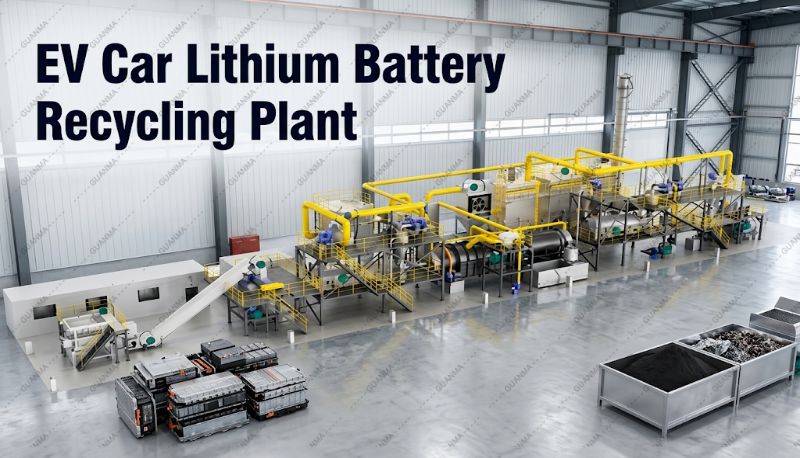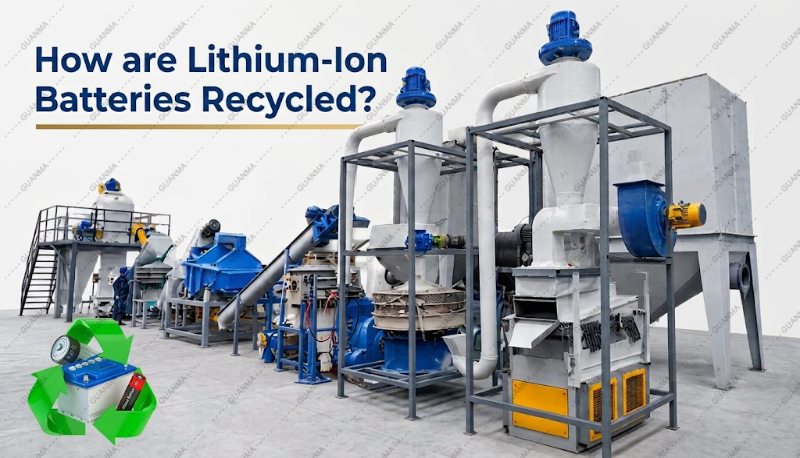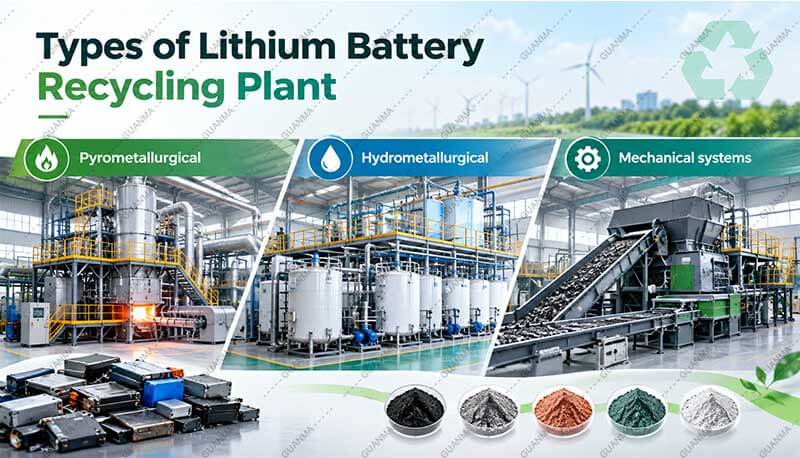
The main equipment used in lithium battery recycling is crushing equipment.drying equipment, conveying equipment, screening equipment.Collection equipment.
Lithium Battery Recycling and Shredding Equipment
There are several types of crushers used for lithium battery recycling.Including single-shaft shredders, double-shaft shredders.and hammer crushers. Different types of lithium batteries require different crusher types. Currently, the most widely used type of lithium battery recycling equipment is the double-shaft shredder. As it offers a more cost-effective and efficient shredding process.
Why choose a hammer crusher? This is determined by the lithium battery casing. Since lithium battery casings are generally made of aluminum or stainless steel.
Which are relatively hard.A hammer crusher uses powerful hammers to break the lithium batteries into the ideal size for further processing.
Lithium Battery Recycling and Drying Equipment
The lithium battery drying equipment is one of the most critical components of the entire production line. It dries the material to better collect separators and black powder. Our lithium battery drying ovens are available in models 1000, 1500, and 2000 to meet the diverse needs of our customers.Lithium battery recycling and drying equipment is a key component of the lithium battery resource recovery process.
It is specifically designed to address the challenges of high moisture content. Agglomeration and subsequent sorting and purification of crushed waste lithium batteries. This equipment utilizes a technical solution that combines low-temperature hot air circulation drying with an intelligent temperature control system. This system precisely controls the drying temperature between 60-120°C. Effectively removing moisture from mixed materials such as electrode powder and diaphragm fragments (the moisture content is consistently below 1.5% after drying). It also effectively prevents the loss of valuable metals such as lithium salts and cobalt and nickel due to high-temperature oxidation, thereby ensuring efficient recovery in subsequent hydrometallurgical or pyrometallurgical processes.
Recycling and Conveying Equipment
Conveying equipment includes belt conveyors and screw conveyors. These conveying devices connect each process and are equipped with motors, fans, and other equipment.
In terms of safety and the equipment is equipped with a metal foreign body detection module and an emergency stop button. This allows real-time identification of metal impurities in the material and automatically triggers an alarm to stop the machine, preventing scratches on the conveyor belt or damage to subsequent equipment. To address the dust-prone nature of lithium battery materials
Some models also integrate side sealing baffles and a negative pressure dust extraction interface to reduce dust emission, complying with environmental and occupational health requirements. Furthermore, the equipment supports multiple installation scenarios, including horizontal, and tilted (maximum tilt angle 30°) and the length and conveying path can be flexibly customized to suit the factory layout. Its compact structure and easy maintenance effectively reduce production line space utilization.Making it a key piece of equipment for improving the automation efficiency of the waste lithium battery recycling process and ensuring the safety of material transfer.
Lithium Battery Recycling and Screening Equipment
Screening equipment primarily includes drum screens, or inclined screens, magnetic separators, circular vibrating screens, and airflow separators, primarily for collecting separators and black powder.
Because Lithium battery recycling and screening equipment is a core component for achieving the precise classification and value extraction of used lithium battery materials. It is primarily used to separate crushed mixed materials (including positive electrode powder, negative electrode graphite, separator fragments, and metal casing particles). laying the foundation for subsequent valuable metal recovery.
This equipment utilizes a combination of multi-stage vibratory screening and airflow sorting technology. Using customized screens (with apertures ranging from 0.2-5mm) and adjustable airflow intensity. It efficiently separates materials of varying particle sizes and densities. For example, it can precisely separate positive electrode active material powder . A particle size of less than 0.5mm from metal casing particles greater than 1mm. The resulting separation purity can exceed 95%. Significantly reducing the complexity of subsequent purification processes.
Battery Recycling and Collection Equipment
The primary purpose of lithium battery recycling and collection equipment is to collect black powder and separators.Then While also removing a small amount of impurities. The back-end section also collects copper and aluminum.
Collection equipment is the “end-of-line collection center” of the waste lithium battery recycling process. It is primarily responsible for sorting. Collecting. So temporarily storing various materials (such as high-purity cathode powder, cathode graphite, metal scraps, and discarded separators) . After screening and purification processes. Ensuring subsequent material transfer and further processing or harmless disposal.
The equipment utilizes a multi-bin design.With each collection bin dedicated to a specific target material. Precise material guide valves prevent cross-mixing of different materials. Ensuring the purity of the collected materials matches that of previous processing. The bin volume can be customized from 1m³ to 10m³.Depending on the production line’s capacity (accommodating 500kg/h-10t/h). Meeting the material storage needs of production scales of varying sizes.
📩 Get Your Free Quote Today
Contact us today to discuss your project, capacity requirements, and target materials. Our team will reply within 24 hours with a customized proposal. You can also reach us directly at [email protected] — we are here to help!