

Home » Lead Refining Furnace

Lead Refining Furnace
Our Lead Refining Furnace removes Cu, Sb, Sn, Ag & Bi to deliver 99.985 % pure lead. Contact Guanma Machinery for lead refining furnace price.
Product Description
If you are searching for a Lead Refining Furnace, Lead Refining Process, that guarantees 99.97–99.985 % purity, Guanma Machinery delivers the full technical picture.
Raw Material
Crude lead / hard lead from Lead Smelting Rotary Furnace
Lead bullion from blast furnace, QSL, Isasmelt, Kivcet or Ausmelt
Battery scrap lead with high Sb, Cu, Sn, As, Bi, Ag, Zn
Anode slime, lead matte & other lead-bearing secondaries

Crude Lead

Crude Lead
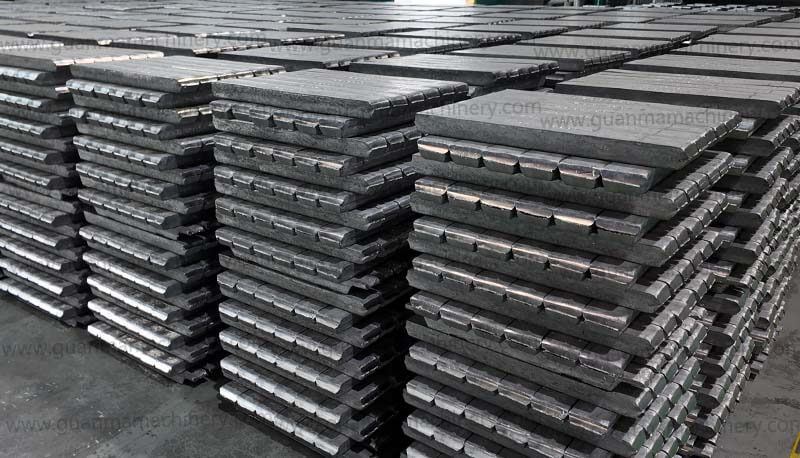
Lead Alloy Ingots
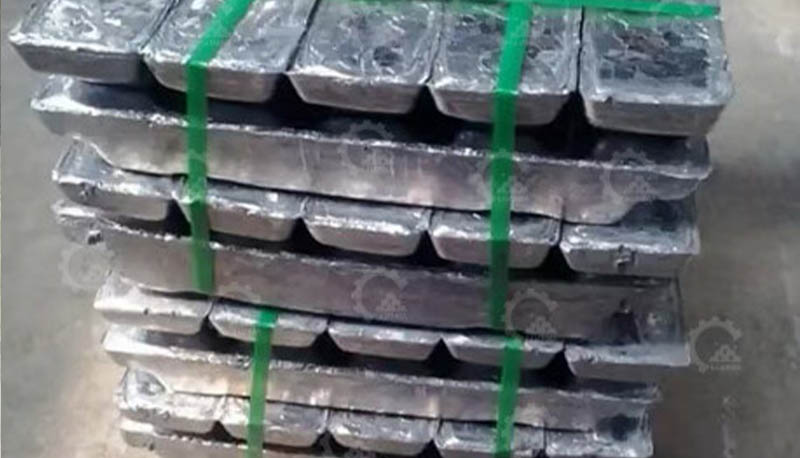
Lead Refined
Final Product
| Product | Typical Purity | Ingot Weight | Application |
|---|---|---|---|
| Refined soft lead | 99.985 % Pb (LME 985R) | 25 kg, 40 kg, 48 kg | Battery oxide, chemicals, sheet |
| Refined soft lead | 99.99 % Pb (LME 990R) | 25 kg, 40 kg, 48 kg | X-ray shielding, pigments |
| Lead-antimony alloy | Sb 2–6 % | 25 kg | Grid metal for flooded batteries |
| Lead-calcium alloy | Ca 0.06–0.10 % | 25 kg | Maintenance-free VRLA batteries |
| Anode slime by-product | Ag 2,000–16,000 g/t | — | Silver & gold recovery |
Flow Chart

Lead Refining Process
The Lead Refining Process of our plant is designed with advanced technology to ensure high efficiency, low energy consumption, and minimal environmental impact. The key steps are as follows:
Step 1: Melting and Pre-Treatment
Crude lead raw materials are fed into the Lead Refining Furnace. The furnace heats the materials to 327-400°C to melt them into liquid lead. During this stage, impurities like iron, zinc, and arsenic are removed through chemical reactions and sedimentation.
Step 2: Desilvering (Optional)
If the crude lead contains silver, a desilvering process is applied using the Parkes process or electrolytic method. This step recovers precious metals, increasing the economic value of the production process.
Step 3: Purification and Dross Removal
Liquid lead is transferred to a purification tank, where chemicals are added to remove remaining impurities such as copper, tin, and bismuth. The generated dross is continuously skimmed off to ensure the purity of the lead.
Step 4: Casting and Cooling
The purified liquid lead is poured into molds to form lead ingots or other shapes. The casting process is automated with precise temperature control to ensure uniform product quality. After casting, the lead products are cooled naturally or through a cooling system to reach room temperature.
Step 5: Quality Inspection
Each batch of final products undergoes strict quality inspection to ensure purity meets the required standards. Only qualified products are packaged and delivered.
Technical Parameter
| Items | Technical Data |
|---|---|
| Capacity of the Refinery Furnace | 30 t, 60 t, 100 t, 120 t/Furnace |
| Quantity of the Refinery Furnace | Based on Processing Capacity |
| Melting Temp | 400–650 °C |
| Heating Type | NGP + Compressed Air |
| Power of Burner Blower | Based on Processing Capacity |
| NGP Consumption | 60–200 m³/h, Two Burners/Furnace |
| Ingot Casting Capacity | 10–30 t/h |
| Consumption of Circulation Cooling Water | 5–20 m³/h |
| Lead Ingot Weight | 25 kg, 45 kg |
| Lead Ingot Purity | ≥ 99.985 % |
| Total Power | Based on Processing Capacity |
Advantages of Modern Lead Refining Furnaces
High Metal Recovery Rate
Modern furnaces (such as rotary furnaces) feature good sealing and thorough mixing, minimizing the loss of lead and other valuable metals (e.g., silver, gold, antimony) in slag and dust. The lead content reaches at least 99.985%.
Efficient Flue Gas Treatment
The generated flue gas is concentrated and stable, facilitating the integration of highly efficient dust collection systems and desulfurization units. This ensures that sulfur dioxide and lead-containing dust emissions meet environmental standards.
High Automation Level and Safe Working Environment
Computer-controlled automation of charging, lead tapping, and temperature regulation is achievable. This reduces manual operation, lowers workers’ risk of exposure to lead dust, and enhances production stability and safety.
Strong Production Flexibility
Modern lead refining furnaces, particularly, exhibit strong adaptability to feed materials. They can process various solid or liquid intermediate products, such as lead paste, scrap anodes, and lead slag, making them highly suitable for secondary lead (e.g., waste battery) processing.
High Labor Productivity
With large single-furnace processing capacity and automated operation, fewer operators are required, leading to high output per capita.
Related Products


Contact Us
Please specify your requirement by referring to the following aspects:
1-What kind of raw material do you want to process?
2-How many tons raw material do you want to process per day?
3-When will you want to start this project?
4-How is your budget of machine?
5-Which point that you really focus on?(We have customized service for each client)